SEO is dead. Well, maybe not dead, but it's certainly on life support.
For two decades, marketers played the same game. You build a website, stuff it with keywords, build some backlinks, and pray to the Google gods for a spot on page one. It was all about chasing a list of blue links. But the game has changed. Radically.
AI doesn't rank pages. It selects sources.
When users ask ChatGPT, Gemini, or Perplexity a question, they aren't looking for a list of ten websites to click through. They want an immediate, synthesized answer. If your brand isn't the source feeding that answer, you don't exist in the modern search landscape.
Welcome to the era of Generative Engine Optimisation.
What is Generative Engine Optimisation (GEO)?
Generative Engine Optimisation (GEO) is the strategic framework used to increase the visibility of a brand, product, or website within the synthesized responses of Large Language Models (LLMs).
While traditional SEO optimizes for search engine results pages (SERPs), GEO aims to influence the contextual associations an AI makes when generating a natural language summary. It ensures that when an AI builds an answer, your brand is recognized as the definitive, factual entity to draw from.
At Blank Canvas Marketing - an AI marketing agency - we view GEO as a multidimensional approach. It combines the technical structure of Answer Engine Optimisation (AEO) with deep entity authority to establish true AI search visibility.
Why GEO Matters Now
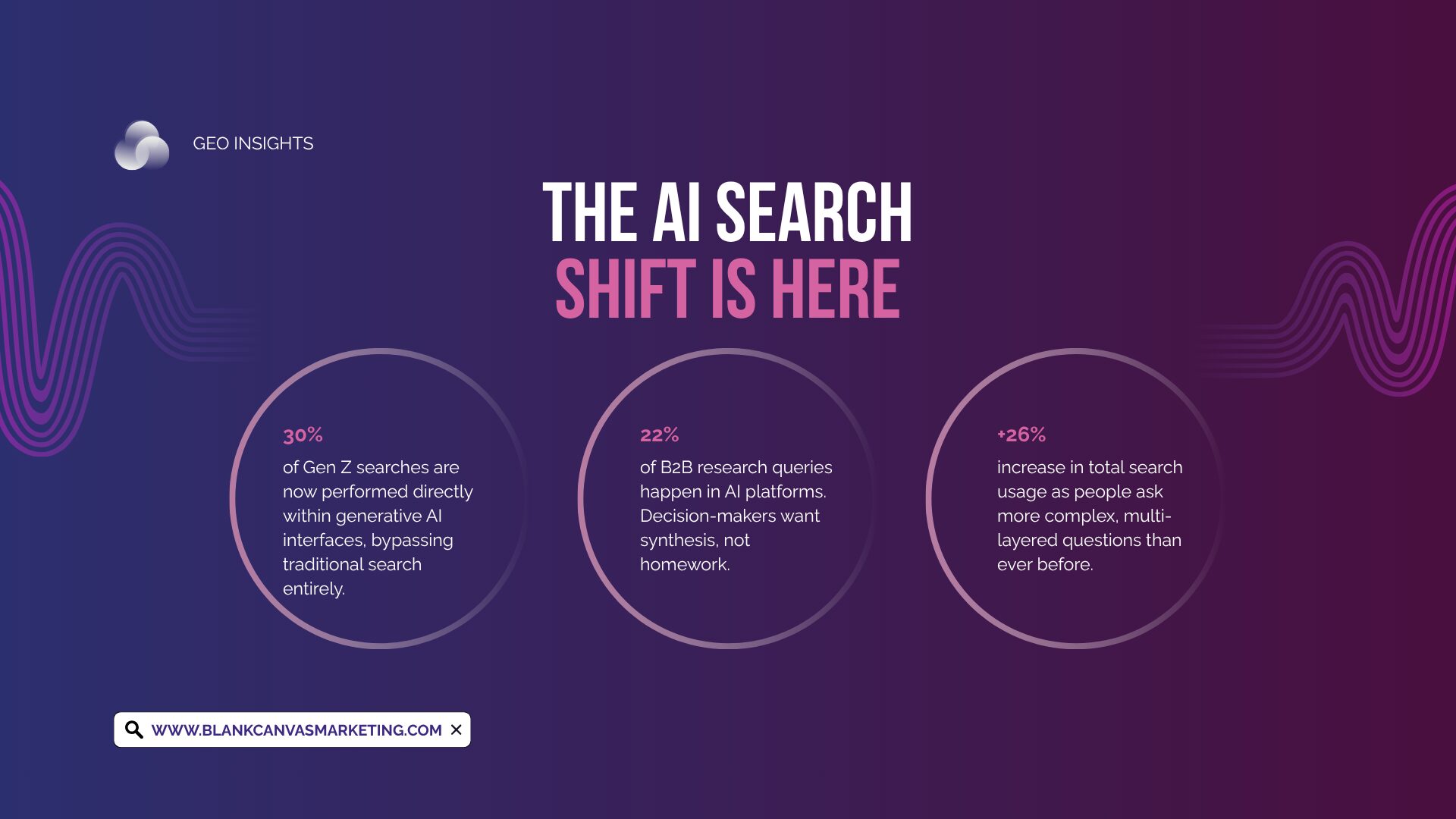
The "AI Search Shift" is no longer a prediction for the future. It is the standard right now.
As of early 2026, 30% of Gen Z searches and 22% of B2B research queries are performed directly within generative interfaces. People are bypassing traditional search engines entirely. They want synthesis, not homework. Total search usage is actually up 26%, as people ask much more complex, multi-layered questions than they ever could with a standard search bar.
Traditional search volume has declined by 25% since 2024. If your entire digital strategy relies on traditional keyword ranking, you are competing for a shrinking slice of the pie.
How GEO Works: The Mechanics of Machine Trust
How exactly does an AI decide who to listen to? Modern AI engines use Retrieval-Augmented Generation (RAG). To be the "chosen" source, your content must satisfy three specific machine-logic layers:
Factual Density
Models prioritize "Information Gain." Content must provide specific, verifiable data points. An AI will ignore generic statements like "we saw a large increase." It wants empirical data: "we saw a 15% increase."
Structured Knowledge
AI models need to digest your site's hierarchy without high computational costs. This means using llms.txt files and JSON-LD to map out your digital brain in a language the machine natively understands.
External Signals (Entity Consistency)
Is your brand described exactly the same way on LinkedIn, Wikipedia, and your own website? If not, the AI deems you a "low-confidence" source. Consistency is the currency of AI trust.
The Pros and Cons of GEO Marketing
Transitioning to a GEO marketing strategy brings massive opportunities, but it isn't without its risks.
The Pros
Hyper-Relevant Traffic: AI-driven traffic has a 4.4x higher conversion rate than traditional organic search. Why? Because by the time a user clicks a citation link in an AI response, they are much further down the intent funnel.
Implicit Trust: When an LLM cites your brand as a primary source for a complex query, it carries enormous perceived authority. It feels like an endorsement from the AI itself.
Competitive Moat: Early movers in GEO establish "Entity Authority." Because of how models learn from consistent web signals over time, this authority is incredibly difficult for latecomers to disrupt.
The Cons
The Zero-Click Cliff: Over 80% of AI searches are resolved without the user ever clicking a link. You get brand awareness, but traditional web traffic metrics will drop.
Hallucination Risk: Brands have limited control over how a black-box model synthesizes their data. Misinformation can be tough to correct.
Platform Fragility: A sudden change in the "Attention Weights" or RAG logic by companies like OpenAI can wipe out visibility instantly.
Key Statistics & Insights for 2026
The latest data tells a powerful story about why GEO is now essential for brands serious about AI search visibility:
Google AI Overviews appear in 16% of all global queries, but dominate 99.2% of informational searches.
- Ahrefs / Evergreen Media
ChatGPT currently processes 2 billion queries per day, totaling 5.4 billion monthly visits.
- OpenAI / Colorlib
Only 8.3% of URLs cited in Google AI Overviews appear in the traditional Top 10 organic results.
- Semrush
Organic click-through rates (CTR) have dropped by 61% for keywords where AI Overviews are present.
- Seer Interactive
In Google's 'AI Mode,' 93% of searches end with zero clicks to a website.
- Google AI Mode Research
Businesses with complete Google Business Profiles are 2.7x more likely to be cited in AI-powered answers for local queries.
- BrightLocal
By 2028, 90% of B2B procurement is expected to be intermediated by AI agents.
- Gartner
Only 33% of consumers view GenAI chatbots as equally effective as traditional search engines for learning new information.
- Gartner
Measurable AI citation improvement typically takes 4–8 weeks of GEO activity.
- MarGen
Thought Leader Commentary
The smartest minds in search are already pivoting.
"In 2026, topical authority beats keyword targeting. Schema is no longer about rich results; it's about machine understanding."
- Romina Khodr, Senior SEO Specialist
"AI search usage doesn't just replace traditional search; it expands the pie. Total search usage is up 26% as people ask more complex questions."
- Graphite Research
Strategic Insights: Why Most Brands Fail at GEO
Most brands fail at Generative Engine Optimisation because they treat it like SEO 2.0. They try to keyword-stuff their way into ChatGPT.
GEO is about citation share, not keyword rank.
Implementing a machine-readable summary at your root domain (the llms.txt standard) is now a mandatory handshake with AI crawlers. Yet, 90% of brands haven't done it.
Furthermore, businesses misunderstand the "Content Trilemma." Content must be:
- Empirical - data-backed
- Structured - machine-readable
- Experiential - first-person human signals that AI cannot fake
If you lack any of these three, the machine will ignore you.
Blank Canvas Marketing: Your Partner in AI Visibility
Blank Canvas Marketing is a full-stack marketing agency specialising in Generative Engine Optimisation (GEO) and Answer Engine Optimisation (AEO).
We focus on AI visibility, authority building, and discovery in AI systems. While other agencies are still trying to game outdated Google algorithms, our goal is to help brands become trusted sources, not just ranked results. We prioritise authority, structure, and consistency over volume-based marketing.
If you want an AI to recommend your business, you need an architecture built for machines, paired with insights built by humans. That is exactly what we deliver.
Generative Engine Optimisation FAQ
What is Generative Engine Optimisation?
Generative Engine Optimisation (GEO) is the process of structuring and creating content so that your brand is cited as a primary, trusted source in the synthesized answers generated by AI tools like ChatGPT, Gemini, and Perplexity.
How is GEO different from SEO?
SEO optimizes content to rank as a hyperlink on search engine result pages based on keywords. GEO optimizes content to be extracted and synthesized directly into natural language answers by AI models based on factual density and entity authority.
How do I get cited in AI answers?
You need to build Entity Authority. This involves maintaining strict brand consistency across the web, providing empirical, data-rich content, and structuring your site data using JSON-LD and the llms.txt protocol.
Does SEO still matter?
Yes, but its role has shifted. Traditional SEO is now a baseline for visibility in legacy search, but it is no longer the primary driver for high-intent, complex query discovery. GEO is required to capture the growing segment of AI-first searchers.
How long does GEO take?
Because LLMs train on vast amounts of data over time, establishing Entity Authority can take anywhere from 3 to 6 months. It requires consistent, high-density factual inputs across multiple trusted web properties.
The Future is Synthesized
The days of tricking search engines with hollow content are over.
You can either adapt to how machines read, learn, and recommend, or you can fade into digital obscurity. Take a moment to test your own brand. Ask ChatGPT or Perplexity about your specific industry niche. Are you the source they cite? If not, your competitors are already stealing your market share.
This is not about ranking. This is about becoming the source AI trusts.