Marketing budgets are currently bleeding cash into outdated strategies. Founders and CMOs continue to pour money into keyword-stuffed blog posts, hoping to capture clicks that simply no longer exist.
Generative engines changed the rules. The era of "ranking for clicks" is dead. We are now in the era of "optimizing for AI citations."
AI doesn't rank pages. It selects sources.
If your marketing budget is still entirely allocated to traditional search, you are funding a strategy built for 2020. By the end of 2026, the transition from navigational search to answer-based consumption will fundamentally alter how businesses capture attention, generate leads, and drive revenue.
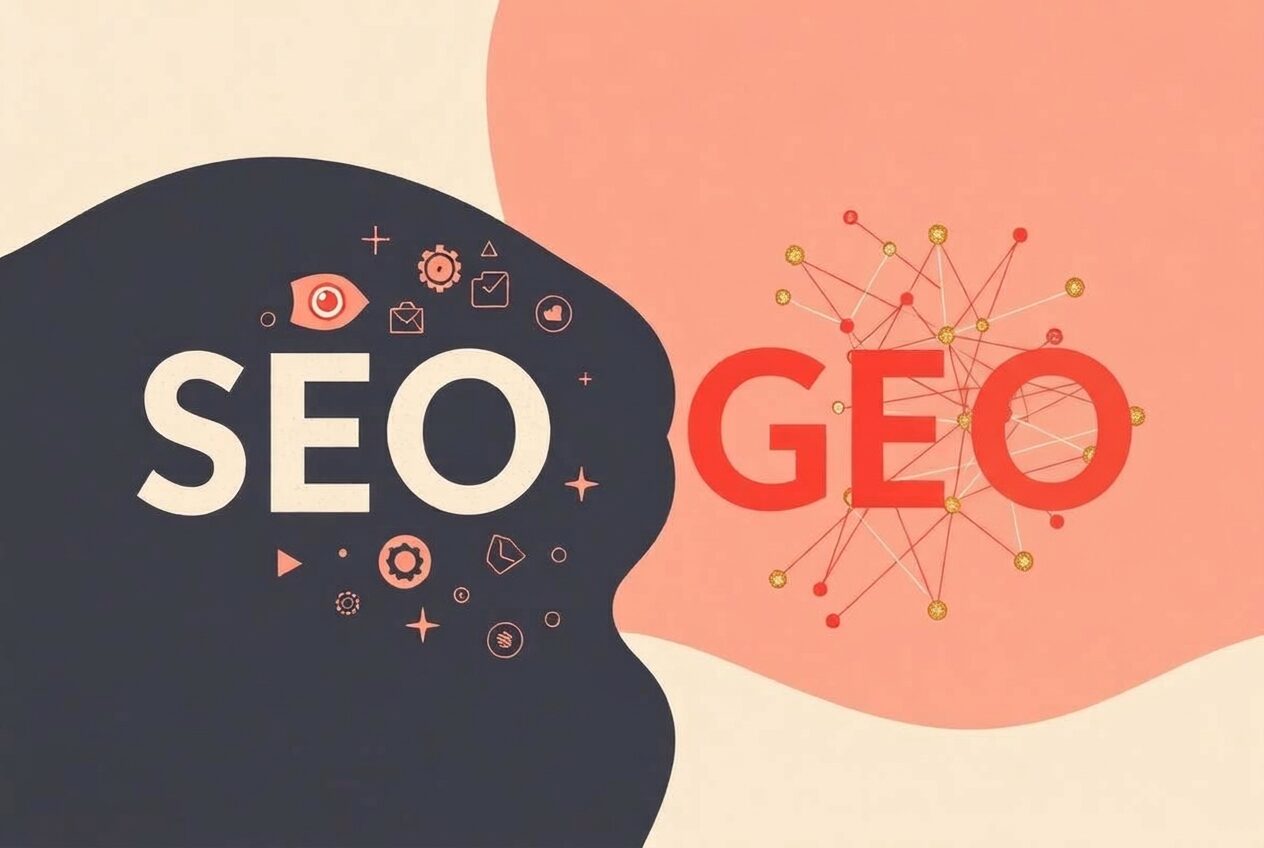
Here is exactly what the shift from Search Engine Optimization (SEO) to Generative Engine Optimization (GEO) actually means, and how you need to restructure your budget to survive.
The Core Difference Between SEO and GEO
We are witnessing a massive evolution in user intent. People no longer want to hunt through a list of blue links to find a solution. They want a definitive, synthesized answer delivered instantly.
Traditional SEO
Treats the user like a researcher. Assumes they want a list of options or sources. The primary goal is to rank in the top three spots on a Search Engine Results Page (SERP) to drive an organic click. You measure success through impressions and Click-Through Rate (CTR). You manipulate keyword density, build backlinks, and tweak technical health.
Generative Engine Optimization (GEO)
Understands that the user wants an immediate, authoritative answer. The primary goal is not to win a click, but to secure a "citation" within an AI-generated response. Instead of keyword density, success relies on Retrieval-Augmented Generation (RAG) and E-E-A-T (Experience, Expertise, Authoritativeness, and Trustworthiness). You measure success through Citation Frequency and your Share of Model (SoM).
The Budget Shift: Where Money Must Go in 2026
Budgets are no longer "SEO-only." The bottom line for 2026 is clear: maintain 60% of your budget for traditional SEO - it remains the foundation - but pivot 40% toward GEO and brand authority. You must capture the high-value traffic currently being siphoned by generative engines.
Structured Data and Schema (High Priority)
AI models like GPT-4o and Gemini 1.5 Pro do not read the internet like humans do. They rely heavily on structured product data to verify facts quickly. If your data is messy, the AI will ignore you. Investing in flawless structured data and schema markup is the most critical technical investment you can make this year.
Digital PR and Brand Mentions
GEO rewards brands mentioned across high-authority, third-party sites. The AI looks for consensus. Getting your brand discussed naturally on Reddit, Quora, and niche industry forums proves to the AI that you are a recognized entity. Spending money on "Authoritative Distribution" involves getting experts to guest post or be interviewed on the high-authority platforms that AI models use to verify reality.
Original Research and Statistics
Generative engines crave unique data. According to Princeton/Georgia Tech research, adding unique, quantitative data points - so-called "Statistics Addition" - is the single most effective optimization technique for AI visibility, yielding a 41% relative improvement in citation probability. Stop regurgitating what already exists and start funding original research.
What to Stop Spending On Immediately
You must stop funding generic "What is X" blog posts. Top-of-funnel, definitional content is dead. AI Overviews now satisfy these queries directly on the search page. The user gets the answer instantly and never clicks through to your site.
The CTR Collapse
This shift has led to a devastating 61% drop in CTR for informational keywords. Producing low-value, volume-based content is no longer a marketing strategy. It is a waste of capital. AI already knows the basics. You need to stop paying writers to explain them.
Traditional SEO vs. Generative GEO: Pros and Cons
Every CMO needs a balanced understanding of what these channels can and cannot do.
Traditional SEO
The Pros: It is highly stable and predictable. Traditional search remains the number one driver for bottom-of-funnel, "buy now" intent. When someone knows exactly what they want to purchase, traditional search still delivers.
The Cons: You are facing a severe "CTR Collapse." Search marketing is expected to lose 25% of its traditional search volume to AI chatbots by the end of 2026.
Generative GEO
The Pros: The traffic is incredibly lucrative. Visitors arriving from AI chats are worth 4.4x more than those from traditional organic search (Semrush). They arrive further along the buyer's journey because their intent is already refined by the AI's dialogue.
The Cons: You have to deal with "black box" reporting. Attribution is incredibly difficult because AI platforms rarely provide granular referral data. You will see the revenue increase, but tracking the exact path is murky.
The Hard Stats and Trends Defining 2026
The numbers speak for themselves. You cannot ignore the fundamental behavioral shifts happening right now.
- The Zero-Click Surge: Zero-click searches have jumped from 56% to an astonishing 69% since the full rollout of AI Overviews. People get the answer and leave.
- Massive Traffic Shifts: AI search traffic increased 527% year-over-year. The migration is happening faster than most brands can adapt.
- The CTR Impact: Ranking #1 in traditional search now yields 34% fewer clicks when an AI Overview is present. Your prized first-place ranking is losing its value by the day.
ROI and Efficiency: Volume vs. Intent
Marketing efficiency in 2026 is measured by Authority vs. Traffic. Traditional SEO ROI is driven strictly by volume. You get massive reach, but you suffer from lower conversion rates, which average around 3%. You cast a massive net to catch a few fish.
GEO ROI is driven entirely by intent. The sheer volume of traffic is lower, but the conversion rates from platforms like ChatGPT and Perplexity are significantly higher than traditional search.
GEO delivers a significantly lower Cost Per Acquisition (CPA) because the generative engine acts as a "pre-sales" filter.
It answers the prospect's technical questions, refines their needs, and sends them to your site only when they are fully primed to buy. This creates a massive efficiency play, especially for B2B SaaS companies.
The Industry Shift: Welcome to the Citation Economy
The dominant trend for 2026 is the rise of GEO-as-a-Service. Agencies and brands must move away from archaic "link building" and focus aggressively on "citation building."
"In SEO, position one wins the click. In GEO, even if your URL is cited first, you lose unless your brand is corroborated across multiple sources."
- Joe Levi, CEO of Noise Media Group
Corroboration is the new currency. If an AI model finds your claim on your website, but cannot verify it across trusted industry forums, PR mentions, and authoritative platforms, it will skip you and cite your competitor.
Strategic Insight for Founders and CMOs
To navigate this landscape, you must completely reframe your marketing metrics.
- Ranking ≠ Visibility. A #1 rank at the bottom of a SERP, pushed down beneath massive AI summaries, is virtually worthless. It is vastly more profitable to be the #2 citation inside the AI summary itself.
- Traffic ≠ Influence. Declining overall web traffic is fully expected and should not induce panic. Brand Mentions within AI responses are the new, accurate proxy for market share.
- Authority = Leverage. CMOs must shift content production away from sprawling, long-form essays. You need modular, fact-heavy blocks of content that AI models can easily "chunk" and cite.
Brands must move from merely "ranking" to actually "being the answer."
How Blank Canvas Marketing Leads the Shift
Navigating this transition requires a specialized approach. Blank Canvas Marketing is a full-stack marketing agency specialising in Generative Engine Optimisation (GEO) and Answer Engine Optimisation (AEO). We focus relentlessly on AI search visibility, authority, and discoverability.
We understand that the old metrics are dying. We help brands become trusted sources, not just ranked results. When you partner with us, we help you intelligently shift your budget. We prioritise authority, structure, and distribution over volume-based SEO. We build the digital infrastructure that AI trusts.
The Bottom Line
The transition is already happening. AI search visitors are worth 4.4x more than traditional organic search because they arrive with intent. Is your current content strategy optimized for AI citations, or are you still chasing keyword rankings that no longer drive clicks?
Businesses that do not adapt to generative engines will lose visibility. This is no longer just a tactical marketing adjustment. This is a critical budget decision that will determine your market share for the next decade.
Get Your GEO Budget Strategy